RNDr. Lukáš Félix Pašteka, PhD.

tel. +421-2-9014-9204
email: lukas.f.pastekauniba.sk
office: CH1-323
Currently on research sabbatical at the University of Groningen in Netherlands:
https://www.rug.nl/staff/l.f.pasteka/research
Links to external professional profiles


Research Interests
- Relativistic and QED effects in chemistry
- Properties of heavy and superheavy elements
- Computational protocols for estimates of the theoretical uncertainty
- Atomic and molecular spectroscopy and laser cooling
- Search for new physics (variation of fundamental constants, parity violation in chiral molecules, electron EDM...)
- Fluxional organic molecules
- Molecular photoswitches
Funded Projects
| 2025–2028 | European Commission Horizon-MSCA-Doctoral-Networks project no. 101224007 – Physics and Applications of Negative IONS – consortium member lead |
| 2024–2027 | Slovak Scientific Grant Agency VEGA project no. 1/0254/24: The role of configurational variability in the theoretical description of interactions of molecules and condensed systems – co-investigator |
| 2022–2022 | High-performance computing project HPC17WYUBA: Parity-Violation in Chiral Molecules within the international exchange scheme HPC-Europa3 – principal investigator |
| 2021–2024 | Postdoctoral grant of the Comenius Universiity (GUKPOST): Design and modelling of molecular photo-switches – principal investigator |
| 2021–2024 | Slovak Research and Development Agency project no. APVV-20-0098: Molecular switching under the spotlight – co-investigator |
| 2021–2024 | Slovak Research and Development Agency project no. APVV-20-0127: Towards reliable finite temperature ab initio calculations of moleculesand materials – co-investigator |
| 2018–2022 | European Commission H2020 – ERA Chairs project no. 810701 – Establishing Laboratory for Advanced Materials at the Comenius University – project manager / co-investigator lab websites: link, link |
| 2019–2022 | Slovak Scientific Grant Agency VEGA project no. 1/0777/19: Benchmark calculations of properties, interactions and reactivity of chemical systems – co-investigator |
| 2018–2020 | Slovak Cultural and Educational Grant Agency KEGA educational project no. 014UK-4/2018: Lab courses and post-millennial students – co-investigator |
| 2017–2018 | International research project Molecules in Extreme Environments at the Centre for Advanced Study, Norwegian Academy of Science and Letters, Oslo (NO) – co-investigator |
| 2015–2018 | Slovak Research and Development Agency project no. APVV-15-0105: Noncovalent interactions in systems of increasing complexity – co-investigator |
Selected Publications
Electron correlation and relativistic effects in the excited states of radium monofluoride The radioactive molecule RaF has received a lot of attention due to its promise as a sensitive probe for searches of new physics as well as a powerful testing ground for the performance of ab initio quantum chemistry. Here, we report the spectroscopy of the 14 lowest excited electronic states of RaF compared with the state-of-the-art relativistic Fock-space coupled cluster calculations, which achieve an agreement of ≥99.64% (within ~12 meV) with experiment for all states. The role of high-order electron correlation and quantum electrodynamics effects in the excitation energies is studied and found to be important for all states. | |
Solid-State Photoswitching of Hydrazones Based on Excited-State Intramolecular Proton Transfer |  |
This work describes a new type of photoswitching molecule exhibiting a rare solid-state photochromism with an unexpected red-shift of the absorption maximum. Based on our calculations, a reaction mechanism involving the excited state intramolecular proton transfer (ESIPT) has been proposed, confirmed by a slew of advanced experimental techniques, which also revealed that the observed photochromism is a surface phenomenon. | |
Opportunities for fundamental physics research with radioactive molecules This white paper discusses the untapped discovery potential for fundamental physics using radioactive molecules. A broad scientific case is made based on recent advances in atomic, molecular, nuclear, astrophysical, chemical research both from the experimental and the theoretical point of view. | |
Enhancing the Potential of Fused Heterocycle-Based Triarylhydrazone Photoswitches A new class of photoswitches was designed featuring high thermal stability, high photoconversion rates, good addressability, and absorption closer to the visible range compared to other photoswitching molecules of this type. High-quality calculations and advanced ultrafast spectroscopy allowed the nature of the electronic transitions to be resolved, and the light was shed on the mechanism of photoisomerization and de-excitation processes. |  |
Electroweak Nuclear Properties from Single Molecular Ions in a Penning Trap We proposed a new technique that can provide a highly sensitive route to investigate yet-to-be-explored nuclear parity-violating properties using single molecular ions. Sensitivities to these effects are predicted using ab initio calculations. These measurements will enable stringent tests of the weak interaction in stable and short-lived isotopes across the nuclear chart. | |
Large vibrationally induced parity violation effects in CHDBrI+ | |
Toward Detection of the Molecular Parity Violation in Chiral Ru(acac)3 and Os(acac)3 In this theory-experiment investigation, helically chiral organometallic compounds are identified as candidates for next-generation experiments for detection of molecular parity violation in vibrational spectra. The parity violating effects exceed by up to 2 orders of magnitude the projected instrumental sensitivity of the ultrahigh resolution experiment under construction at the Laboratoire de Physique des Lasers in Paris. |  |
Stereomutation of Substituted Bullvalenes Boronate Ester Bullvalenes These two papers build upon our previous investigation of bullvalene (below) and extend the reraangement graph analysis and automatic PES exploration to bullvalenes containing stereogenic substituents, tethered bullvalenes, and new syntetic routes. Introducing chirality upends the usual symmetries in the reaction graphs, but also introduces new ones. |  |
The electron affinity of astatine In this collaboration with CERN ISOLDE, the value of the electron affinity of astatine was determined in a parallel-blind study for the first time experimentally and computationally matching both results with an unprecedented level of accuracy. |  |
Material Size Dependence on Fundamental Constants We presented a completely new pathway in detecting the variation of fundamental constants and/or topological dark matter using laser interferometry and mass resonance. This approach is based on changes in the lattice parameters of selected solids due to the changes in the fine structure constant and proton-to-electron mass ratio, and offers sensitivity surpassing previously used techniques. |  |
Synthesis and Analysis of Substituted Bullvalenes Bullvalene is a shapeshifting molecule without a permanent structure at ambient conditions. Alongside a new two-step synthetic route, we have developed an algorithm efficiently exploring the entire energy landscape based on a rearrangement graph connecting bullvalene's 1.2 million isomers via 1.8 million transition states, and predicting the thermal populations of different substitution patterns. |
|
Relativistic Coupled Cluster Calculations with Variational Quantum Electrodynamics Resolve the Discrepancy between Experiment and Theory Concerning the Electron Affinity and Ionization Potential of Gold |  |
| This work resolved a decades-long standing discrepancy between the theoretical prediction and experimental measurement of the electron affinity of gold. Systematic accounting of all possible sources of error in theory has reduced the discrepancy in the ionization energy and electron affinity to just a few meV – a factor of 10 improvement over past results. The methodology was since applied to other heavy and superheavy elements. | |
Relativistic and quantum electrodynamic effects in superheavy elements A review of the current status of relativistic electronic structure theory for superheavy elements and a discussion the role of quantum electrodynamic effects beyond the no-virtual-pair approximation. Changes in periodic trends due to relativistic effects are outlined and the role of the negative energy states for the electronic stability of superheavy elements beyond the critical nuclear charge is analyzed. | |
 ysical Review Letters 133, 033003 (2024)

Invited Talks
| 2024 | Institute for Nuclear Theory (INT) UW Workshop: Fundamental Physics with Radioactive Molecules – Seattle, WA (US) International Conference on Relativistic Effects in Heavy-Element Chemistry and Physics (REHE) – Amersfoort (NL) Conference on Mathematical Methods in Science and Engineering – Rota (ES) Quantum Metrology and Laser Applications meeting at the Institute for Lasers, Life and Biophotonics (LaserLaB) – Amsterdam (NL) |
| 2023 | Lecturer at Summer School: Search for new physics with low-energy precision tests – Ameland (NL) |
| 2022 | World Association of Theoretical and Computational Chemists Congress (WATOC) – Vancouver (CA) |
| 2021 | International Conference on Relativistic Effects in Heavy-Element Chemistry and Physics (REHE) – online |
| 2020 | Berendsen Center for Multiscale Modeling and Material Design Symposium – Groningen (NL) |
| 2019 | Humboldt Foundation Alumni Meeting (Humboldt Kolleg) – Piešťany (SK) |
| 2018 | MITP Workshop: Searching for New Physics with Cold and Controlled Molecules – Mainz (DE) Atoms, Molecules, and Materials in Extreme Environments – CAS, Oslo (NO) |
| 2017 | Central European Symposium on Theoretical Chemistry (CESTC) – Wisła (PL) |
Teaching
Responsible for the delivery, development and quality assurance of the study programme Theoretical and Computational Chemistry (Master, PhD)
Bachelor's courses:
- Physical Chemistry 1 – leading seminars/tutorials
- Physical Chemistry 2 – leading seminars/tutorials
- What is Physical and Theoretical Chemistry – selected lectures
- Physics 1 (for Biological Chemistry) - selected lectures
- Physics 2 (for Biological Chemistry) - selected lectures
Master's courses:
- Selected Chapters in Theoretical and Computational Chemistry 2 – selected lectures
- Computer Modelling 1, Molecular Characteristics and Reactivity – selected computer labs
- Advanced Programming and Numerical Recipes – selected computer labs
PhD courses:
- Relativistic Effects in Chemistry – selected lectures
- Theoretical Chemistry – selected lectures
- Chemical Reactivity – selected lectures
- Modern Computational Methods in Quantum Chemistry – selected lectures
Science Communication and Outreach
Member of the organization committee of the 17th International Congress of Quantum Chemistry in Bratislava – ICQC 2023

Popular-science talks:
- online issue of Nerd Nite Slovakia
- podcast This Week in Science (TWIS)
- SSC plenary Are we done with the periodic table?
Research featured in popular-science articles and blogs:
- astatine and alpha-therapy – Phys.org, LiveScience, CERN news, C&EN, ChemistryWorld
- varying fundamental constants – InsideScience, PhysicsWorld, ArsTechnica, APS Physics
- gold discrepancy – Phys.org, PhysicsWorld, APS Physics, ScienceNews
- shape-shifting bullvalene – C&EN, Science.org
Evaluating HPC access proposals for the Slovak National Supercomputing Centre
Chemistry correspondence seminar CHEMOUK for motivated high-school students
Demonstrating theoretical chemistry for the FNS Open Day
Preparing and evaluating students for the International Chemistry Olympiad
Co-organizier and author/evaluator of theoretical problems for the 50th International Chemistry Olympiad held in 2018 in Bratislava (SK) & Prague (CZ)
Demonstrating physics experiments at Auckland Museum of Transport and Technology Science Street Fair (NZ) in 2015–2016
Evaluation committee member at the international high-school science project
competitions Stockholm Junior Water Prize and Scientia Pro Futuro held in Bratislava (SK) in 2011–2012
My Science Graphics Design Portfolio contains examples of graphics, covers and logos I have created.
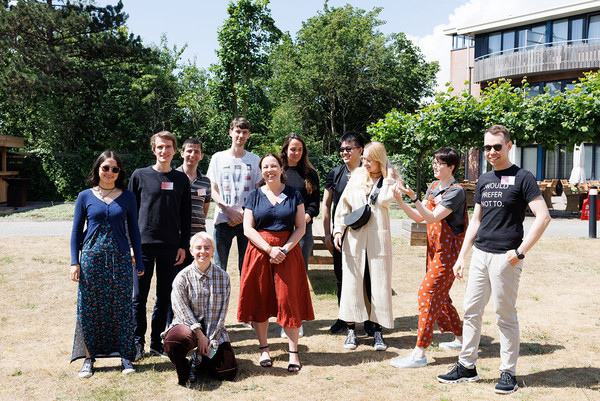
Group pictures