


Chaetonotus (Hystricochaetonotus) optabilis
Reference
Rataj Križanová F. & Vďačný P. (2022) A huge undescribed diversity of the subgenus Hystricochaetonotus (Gastrotricha, Chaetonotidae, Chaetonotus) in Central Europe. European Journal of Taxonomy 840: 1-93. https://doi.org/10.5852/ejt.2022.840.1941
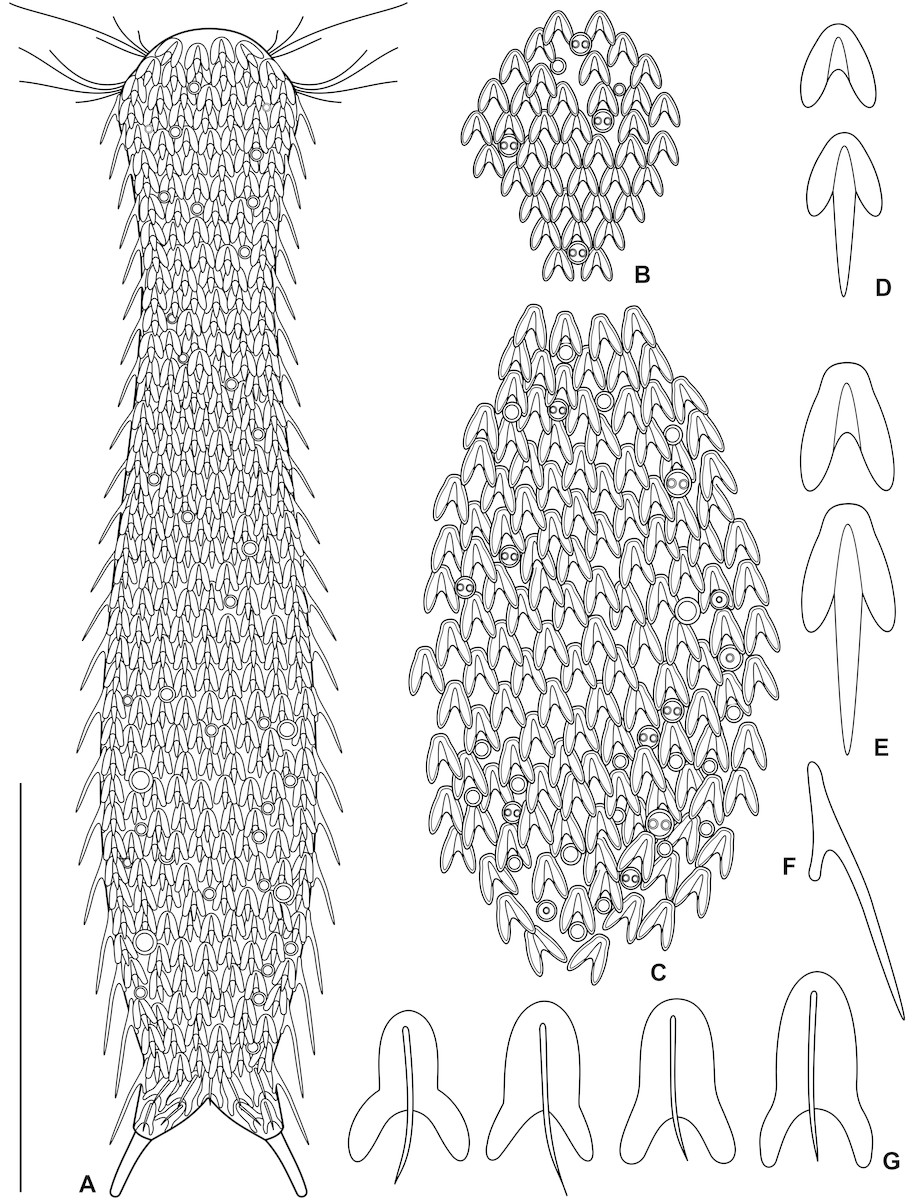
Chaetonotus (Hystricochaetonotus) optabilis, schematic drawings. (A) Dorsal overview showing the scale and spine pattern. (B–C) Details showing the distribution of head and trunk scales. (D–E) Head and trunk scales, the schematic drawing of the scale base is shown above that of spined scales. (F) Lateral view of a trunk spined scale. (G) Dorsal furcal scales. Scale bar: 30 μm.
© 2022 Rataj Križanová F. & Vďačný P. This picture is licensed under a CC BY-NC-ND 4.0 license.
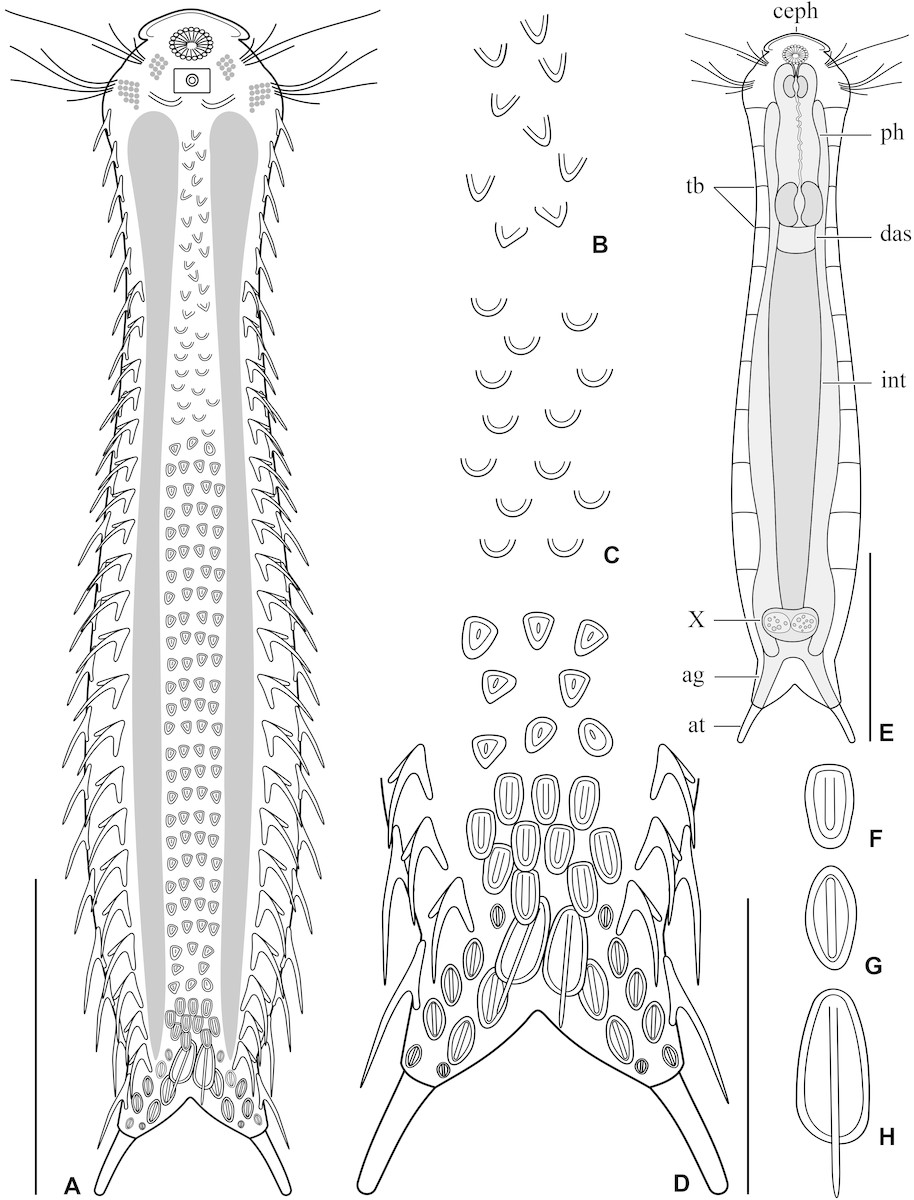
Chaetonotus (Hystricochaetonotus) optabilis, schematic drawings. (A) Ventral overview showing the scale and ciliary pattern. (B) V-shaped scales without keels. (C) Bowl-shaped scales without keels. (D) Detail of the ventral posterior body region. (E) Internal morphology. (F) Narrowly obovate keeled scale. (G) Fusiform keeled scale. (H) Oblong spined scale. Scale bars: 10 μm (D) and 30 μm (A, E).
© 2022 Rataj Križanová F. & Vďačný P. This picture is licensed under a CC BY-NC-ND 4.0 license.
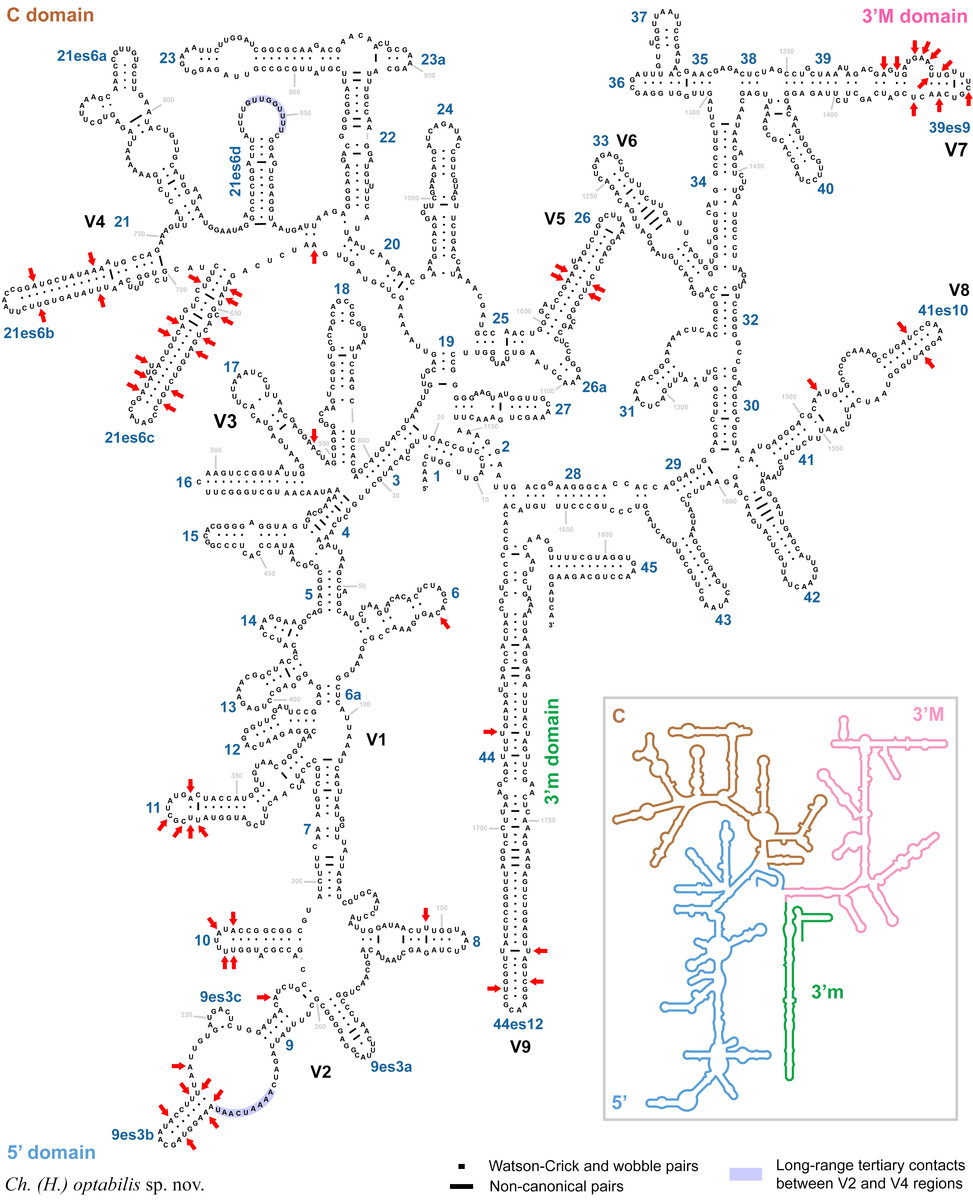
Secondary structure of the 18S rRNA molecule of Chaetonotus (Hystricochaetonotus) optabilis. Diagnostic molecular autapomorphies are marked by red arrows. The reference 18S secondary structure map of Saccharomyces cerevisiae (inset) is from apollo.chemistry.gatech.edu/RibosomeGallery.
© 2022 Rataj Križanová F. & Vďačný P. This picture is licensed under a CC BY-NC-ND 4.0 license.
Suppl._Fig._S14_-_28S-34_DB.tif
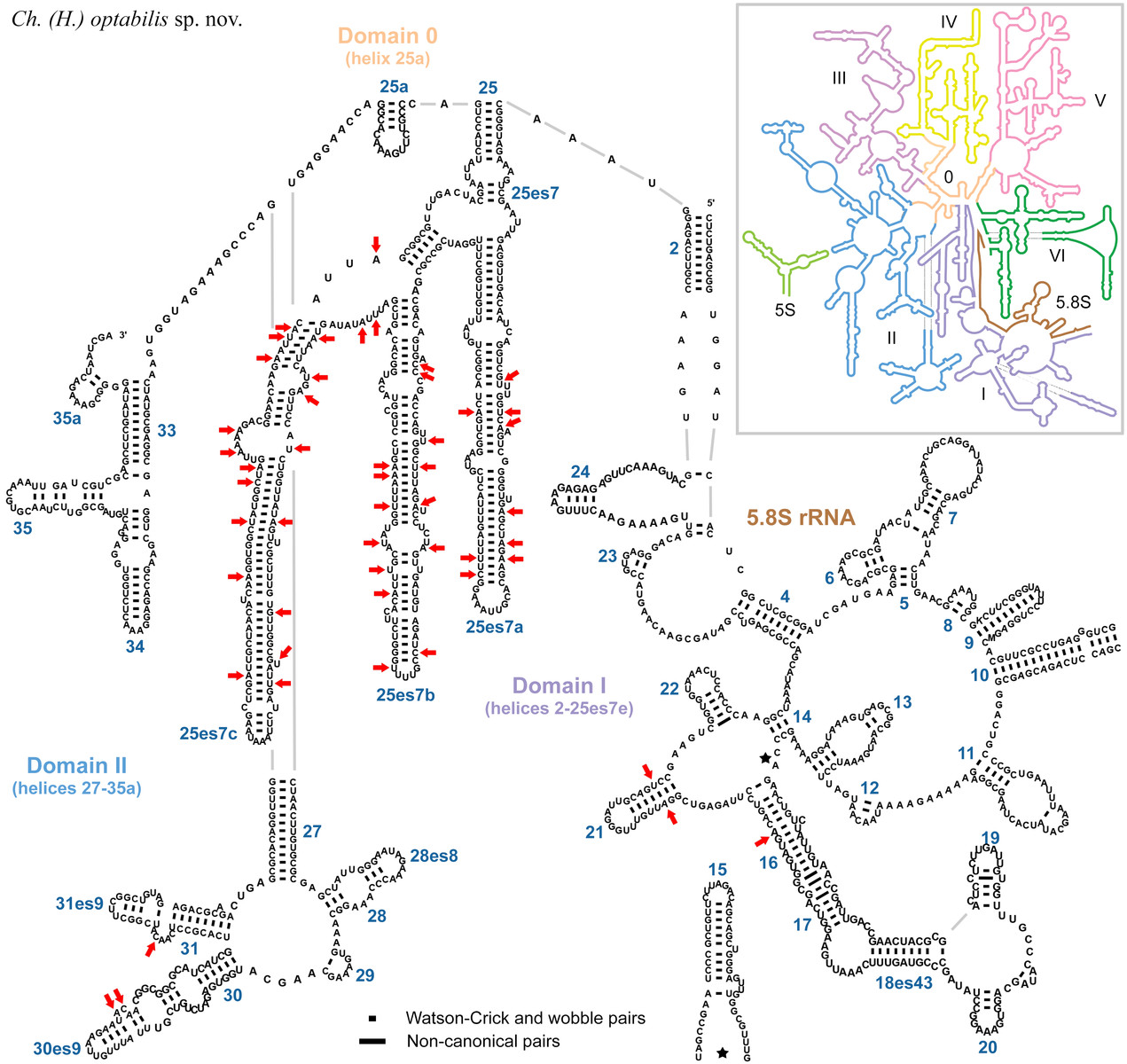
Secondary structure of the first two domains of the 28S rRNA molecule of Chaetonotus (Hystricochaetonotus) optabilis. Diagnostic molecular autapomorphies are marked by red arrows. The reference 28S secondary structure map of Saccharomyces cerevisiae (inset) is from apollo.chemistry.gatech.edu/RibosomeGallery.
© 2022 Rataj Križanová F. & Vďačný P. This picture is licensed under a CC BY-NC-ND 4.0 license.
Morphological diagnosis
Body elongated and about 108‒143 μm long. Head slightly wider than neck, separated from trunk by an inconspicuous neck constriction. Cephalion clearly demarcated, epipleurae and hypopleurae not recognizable. Trunk comparatively narrow, not broader than head, widest at ca U63, narrowest at ca U88. Mouth ventral, no cuticular teeth. Hypostomium bears a rectangular cuticular structure accompanied by two posterior lateral lamellae. Pharynx with anterior and posterior dilatations. Intestine straight, with a marked anterior section. Scales slightly overlapping, distributed in 16–18 columns, 40–45 scales per column. Dorsal surface covered from posterior end of cephalion (ca U1) to furca base (U94) with (i) spined, three-lobed scales with rounded anterior end and (ii) spined, three-lobed scales with truncated anterior end. Spines short, narrowed posteriorly, without denticles. Ventral side carries two broad ciliary bands and two pairs of ciliary fields around mouth and hypostomium. Interciliary filed bears (i) V-shaped scales without keels, (ii) bowl-shaped scales without keels, (iii) obtriangular scales with very minute keels, and (iv) narrowly obovate, keeled scales. Furca base longer than adhesive tubes, lateral margins more or less straight, furcal indentation deeply V-shaped, adhesive tubes diverging posteriorly. Dorsal side of furca base and branches covered with three-lobed scales, ventral side with oblong, spined scales and oval to broadly fusiform, keeled scales.
Molecular diagnosis
18S rRNA gene: 78 C, 148 T, 223 A, 225 A, 228 T, 235 A, 239 T, 240 T, 243 A, 264 A, 267 ‒, 282 T, 283 T, 286 A, 288 A, 336 T, 337 T, 338 C, 340 C, 345 A, 546 A, 639 A, 648 T, 649 A, 652 C, 656 T, 658 A, 664 T, 666 T, 676 A, 678 A, 681 T, 686 T, 688 A, 694 T, 714 T, 722 T, 733 A, 741 A, 1059 A, 1060 A, 1082 T, 1083 T, 1366 A, 1368 T, 1372 G, 1373 A, 1374 A, 1376 T, 1377 T, 1381 ‒, 1383 C, 1384 ‒, 1388 A, 1391 T, 1507 A, 1526 T, 1535 A, 1690 T, 1724 T, 1732 C, 1736 T.
28S rRNA gene: 275 A, 292 A, 309 T, 480 T, 485 T, 487 A, 489 ‒, 500 A, 504 A, 506 A, 520 C, 522 T, 543 A, 588 C, 589 C, 591 ‒, 599 T, 603 T, 608 A, 615 A, 628 C, 634 T, 645 A, 648 T, 652 T, 657 T, 661 A, 662 A, 688 T, 690 A, 698 A, 704 T, 706 A, 713 T, 722 A, 735 G, 742 T, 746 T, 764 A, 777 A, 784 T, 789 C, 791 A, 795 A, 798 A, 810 A, 813 T, 814 A, 819 A, 965 A, 966 C, 996 C.
Cytochrome c oxidase subunit I (codon ordinal numbers are followed by the corresponding span of nucleotide positions in parentheses): 20 (58‒60) CTA, 32 (94‒96) AGT, 45 (133‒135) GTC, 49 (145‒147) GCT, 51 (151‒153) GTC, 55 (163‒165) TTC, 57 (169‒171) GTT, 69 (205‒207) CTA, 76 (226‒228) GCG, 77 (229‒231) CCA, 91 (271‒273) TTA, 101 (301‒303) GTG, 109 (325‒327) GCC, 111 (331‒333) ACA, 114 (340‒342) ACG, 133 (397‒399) GCT, 154 (460‒462) ACC, 156 (466‒468) TTA, 184 (550‒552) TTG, 186 (556‒558) TTA, 205 (613‒615) AGG.
Type material
A DNA sample of the holotype specimen DB 34 has been deposited in the Natural History Museum, Vajanského nábrežie 2, 810 06 Bratislava, Slovakia (ID Collection Code 01427607).
Type locality
Ephemeral pond in the floodplain area of the River Morava near the foothill of the Devín castle, Bratislava, Podunajská rovina plain, Slovakia, 48°10′29.4″ N, 16°58′35.8″ E.