


HOW PINNIPEDS ACQUIRED THE ABILITY OF AMPHIBIOUS HEARING.
James R. Rule & Martin Sabol
Have you ever wondered how pinnipeds (true seals, eared seals, and walruses) communicate underwater? Like other land mammals, they have well-developed ears for collecting and interpreting sound traveling through the air. However, evolution has arranged it so that, like whales and dolphins, they can also hear underwater. This ability, known as amphibious hearing, is unique among mammals. Although it has been known for a long time, the question of when and how this ability evolved has remained unresolved. An international team of scientists led by James P. Rule from the Natural History Museum in London and Monash University in Clayton sought to answer this question.
In land mammals, airborne sound travels through our ear canals to the middle ear and from there to the inner ear, where it is processed. In water, however, sound travels four times faster and travels through muscles and bones directly to the inner ear, bypassing the middle ear. This causes that land mammals can only hear sound in water to a muffled degree. Pinnipeds, however, hear sound traveling through water clearly. How is this possible?
3D scans of the ear cavities of modern pinnipeds have shown that their ear canals and middle ears contain cavernous tissue, which is associated with the evolution of amphibious hearing. This is a "spongy" type of richly vascularized tissue that fills with blood and expands in the ears of pinnipeds as they dive, equalizing the air pressure inside their ears. This means that underwater sounds travelling through the cavernous tissue lose only about 1% of the sound signal, in contrast to 99% in the case of land mammals, whose ears would still be filled with air.
Subsequent comparison and analysis of the ear cavities of extinct pinnipeds and their ancestors, as well as other caniform carnivorans, revealed that amphibious hearing evolved in pinnipeds about 26 million years ago. Although this new evolutionary ability was initially poorer, it gradually improved, and by about 13 million years ago, true seals, such as Devinophoca described from the Miocene sediments of Devínska Kobyla, had developed a modified middle ear capable of acute hearing in both environments. A similar evolution process occurred also independently in eared seals.
More details about all this research, as well as other remarkable acoustic abilities of pinnipeds (such as ultrasonic singing), were provided by a new study published in Proceedings of the Royal Society B: Biological Sciences, the results of which were presented to the public in The Conversation (see links below).
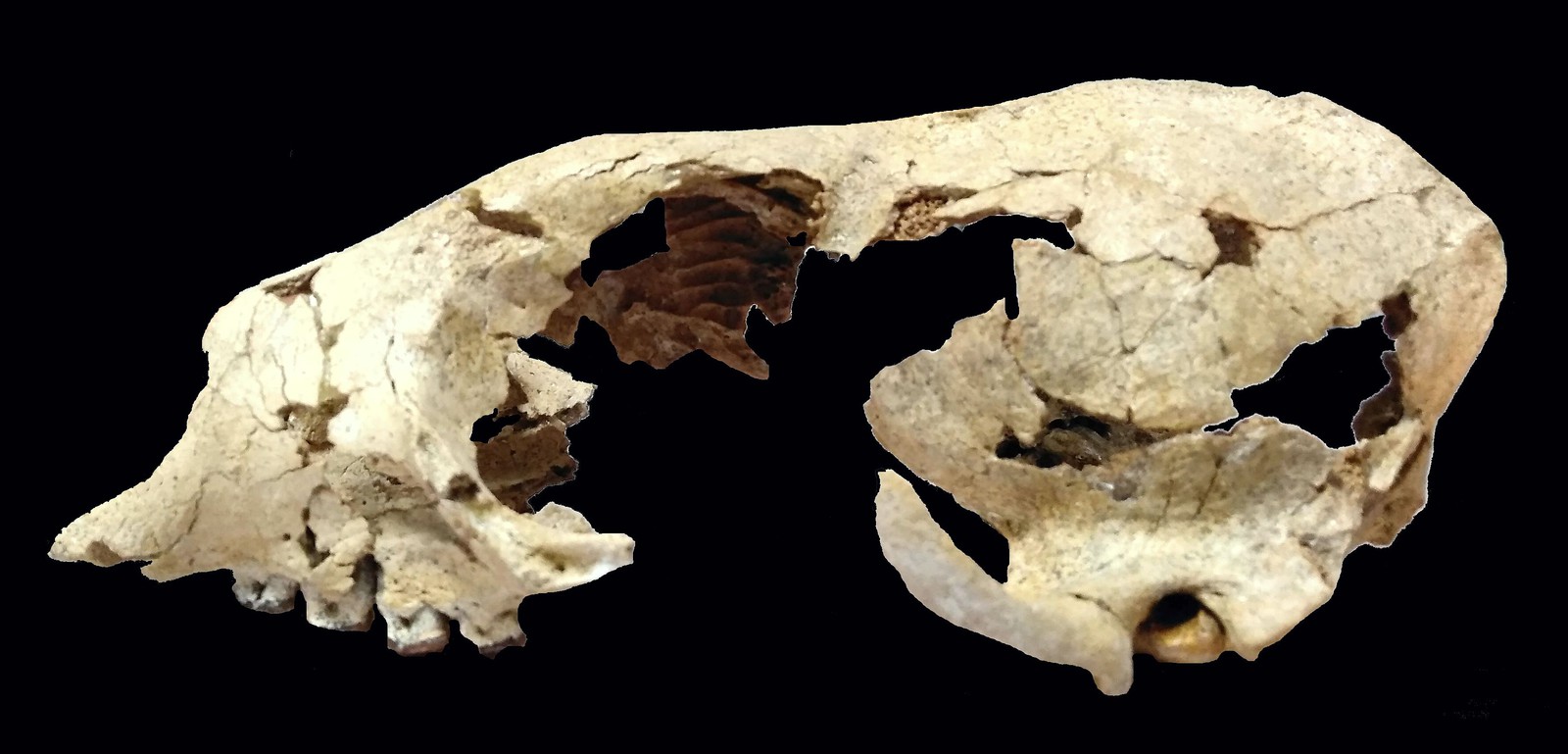
Skull of seal species Devinophoca claytoni from the Miocene sediments of Devínska Kobyla hill.